

Written and reviewed by Firoz Jetha · Updated September 2026
SPaG and comprehension test different but closely connected English skills in the QE Boys 11+ examination. SPaG focuses on spelling, punctuation and grammar, while comprehension assesses how accurately a child can understand, interpret and draw conclusions from a passage.
If your son is preparing for the QE Boys 11+ exam, you may already have discovered how demanding the English paper can be.
On the surface, SPaG can appear easier: shorter questions, clear rules and answers that are usually either right or wrong. Comprehension may seem less predictable, with longer passages, unfamiliar vocabulary and questions requiring careful interpretation.
In practice, neither area should be underestimated. A child may know the relevant grammar rules but lose marks through rushed reading, while a strong reader may still have gaps in punctuation, spelling or grammatical terminology. Effective preparation therefore needs to develop both skill sets while identifying where marks are actually being lost.
This guide explains the difference between SPaG and comprehension, provides original example questions and offers practical advice for preparing for both aspects of QE Boys 11+ English.
The examples in this article illustrate the skills required. They are original Achieve Learning questions and are not taken from a live QE entrance examination. Their format and level are informed by our experience and feedback received from candidates following previous sittings.
What Pattern Has the QE Boys 11+ English Exam Followed in Recent Years?
Queen Elizabeth’s School officially confirms that candidates sit multiple-choice tests in English and Maths. However, the school does not publish or guarantee the precise structure of future English papers and cautions that preparation materials may not reflect the format of its entrance examination.
Based on feedback received by Achieve Learning from students after recent QE Boys entrance examinations, the English paper has followed a recognisable pattern. Candidates have typically encountered:
- two demanding comprehension passages, each followed by approximately 15–20 multiple-choice questions;
- a spelling section containing around 10 questions;
- a punctuation section containing around 10 questions; and
- a sentence-completion section of around 10 questions, testing grammar and vocabulary.
This has resulted in approximately 65 English questions: around 35 comprehension questions followed by approximately 30 SPaG questions. Candidates have reported having approximately 45–50 minutes to complete the paper.
Although this has been a consistent pattern in recent sittings, parents should treat it as evidence from previous examinations rather than a guarantee that every future paper will be identical.
What Does This Pattern Demand From Candidates?
- Comprehension requires sustained concentration. Children must read two unfamiliar passages, understand potentially challenging vocabulary, interpret layered meanings and distinguish between several plausible multiple-choice answers.
- SPaG requires accuracy as well as speed. After completing the comprehension passages, candidates must switch to shorter, more rule-based questions covering spelling, punctuation, grammar and vocabulary. Small gaps in knowledge—or rushed reading—can result in avoidable lost marks.
Taken together, the reported format creates a demanding test of both stamina and precision. Children need to manage two extended passages without using so much time that the shorter SPaG sections are rushed.
Achieve Learning insight
This recurring structure is why Achieve Learning’s full QE Boys English practice papers include two comprehension passages followed by dedicated spelling, punctuation and sentence-completion questions. The format is informed by our experience of preparing candidates and feedback received from students following their actual entrance examinations.
How Many Marks Are in the QE Boys 11+ Exam, and How Is It Scored?
Based on the pattern reported in recent examinations, the QE Boys English paper has contained approximately 65 multiple-choice questions: around 35 comprehension questions and 30 questions covering spelling, punctuation, grammar and vocabulary.
For practice and diagnostic purposes, each correct answer can be treated as one raw mark. However, Queen Elizabeth’s School does not publish a maximum raw mark or guarantee the number and weighting of questions in future examinations.
The school confirms that answer sheets are marked electronically and candidates’ scores are age-standardised. The standardised English and Maths scores are then combined to produce a single overall entrance-test score.
What Is the QE Boys Qualifying Score?
Candidates currently need a combined age-standardised score of 225 or higher to be eligible for consideration for admission. Achieving 225 does not guarantee a place: QE has a Published Admission Number of 180 and admission remains highly competitive.
Parents should always check the school’s current entrance-test and scoring information, as its admissions arrangements may change.
What Does This Mean for Preparation?
Every part of the English paper can contribute valuable marks, although comprehension and SPaG are not necessarily weighted equally. It would therefore be a mistake to treat SPaG as an unimportant addition or to prepare only for comprehension.
A child who performs strongly in comprehension but loses avoidable marks in spelling, punctuation or grammar—or the reverse—may significantly reduce his overall English result. Preparation should cover both areas, with extra attention to the question types where marks are regularly lost.
Now, let’s examine the difference between SPaG and comprehension in more detail.
SPaG at QE Boys: What Does It Mean and How Is It Tested?
What Does SPaG Mean in English?
SPaG stands for spelling, punctuation and grammar—the “nuts and bolts” of English that hold sentences together.
It includes knowing the difference between its and it’s, using commas and apostrophes correctly, maintaining consistent verb tenses and recognising whether a sentence is grammatically complete. These skills support children’s reading, writing and comprehension throughout the curriculum.
Selective-school entrance examinations assess SPaG in different ways. Based on feedback received by Achieve Learning from candidates following recent QE Boys examinations, it has appeared through focused multiple-choice sections requiring children to identify errors and complete sentences accurately.
This creates a demanding test of both knowledge and application. Candidates must recognise subtle mistakes, distinguish between plausible answers and work accurately under time pressure.
What SPaG Question Types Have Appeared at QE Boys?
The following three question types have formed part of the recurring pattern reported in recent QE Boys English papers:
- Spelling: Candidates are given a sentence containing a possible spelling error. They must identify which marked word is incorrect or select the option indicating that there is no error. Questions may involve homophones, commonly confused words, irregular spellings and endings such as -ible and -able.
- Punctuation: Candidates must identify a punctuation error or decide that the sentence is correct. This can include missing or incorrectly placed commas, apostrophes, quotation marks and other punctuation.
- Grammar and sentence completion: Candidates select the option that completes a sentence correctly and appropriately. This can test verb tenses, subject–verb agreement, prepositions, sentence structure and vocabulary in context.
Parents should treat these as question types reported in recent examinations rather than a guarantee that every future paper will use exactly the same structure.
Although the questions may initially appear straightforward, the errors and answer choices can be subtle. There is no opportunity to explain the reasoning behind an answer: candidates must identify the correct option accurately and efficiently.
Comprehension should not be approached through instinct either. Both areas demand close reading, but they apply it differently: comprehension requires children to interpret a passage and support conclusions with evidence, whereas SPaG requires them to apply language rules and judge whether individual words or sentences are correct.
Looking for targeted practice? Explore our QE Boys 11+ English practice papers. Each current pack combines two full-length comprehension papers with a bonus SPaG paper, with detailed answers to help identify and address specific weaknesses.
How to Improve SPaG for the 11+
Improving SPaG isn’t about memorising hundreds of random rules, it’s about building confidence with the essentials and then practising them until they become second nature.
Strong performance in 11+ SPaG questions depends on two things:
- Knowing the rule: Children need a secure understanding of apostrophes, verb tenses, sentence structure, punctuation and commonly confused spellings.
- Applying the rule under pressure: Multiple-choice questions may contain several plausible answers, so children must identify subtle errors accurately without spending too long on each sentence.
SPaG revision is usually most effective when it is regular, focused and manageable. 10 minutes a day is far more effective than cramming the week before the test. One day might be apostrophes, another homophones, another verb tenses — keeping practice varied but targeted. This lets you address weaknesses without overwhelming the child.
Most importantly, children shouldn’t just learn “the right answer.” They need to understand why a sentence is correct or incorrect, so they can apply the same logic and avoid mistakes on exam day.
Let’s break it down into the main areas.
How to improve spelling for the 11+
Spelling is one of the simplest areas on paper, but it’s also where children lose marks unnecessarily. In the exam, sentences include words that look almost right, so it’s not enough to “have a good eye.”
For instance, can you spot the mistake below?

Here’s how to tackle it:
- Practise words in context: Word lists can help with initial learning, but children should also encounter and use difficult spellings within complete sentences. This is closer to the way spelling has been tested in recent QE-style questions.
- Study homophones and commonly confused words: Examples include there/their/they’re, stationary/stationery and practice/practise. Ask your child to explain the meaning and grammatical role of each word rather than simply memorising its spelling.
- Recognise common spelling patterns: Double consonants (accommodate), irregular plurals (children, geese), silent letters (rhythm, subtle) and prefixes (inperfect instead of imperfect) are classic exam traps.
- Maintain a personal error list: Record the words your child repeatedly misspells or fails to identify. Revisiting a short individual list is generally more useful than repeatedly studying hundreds of words already known.
- Review mistakes carefully: When an answer is wrong, identify what caused the error. Was the spelling unfamiliar, was the word confused with another, or was the sentence read too quickly?
- Make practice structured: 11 Plus SPaG papers and short quizzes keep spelling sessions manageable and less overwhelming.
The central principle is repeated, meaningful exposure. The more frequently a child encounters difficult words in reading and properly constructed sentences, the easier it becomes to recognise when a spelling is incorrect.
If you’re still deciding on secondary options, don’t miss our QE Boys comparisons with Latymer, Watford Grammar, Tiffin Boys, Dame Alice Owen’s, St Olave’s, Wilson’s School and Habs Boys.
How to improve punctuation for the 11+
Punctuation is where many children slip up, often because they either rush or rely on how a sentence appears rather than applying a clear grammatical rule. In the 11 Plus, punctuation questions are about spotting one subtle error in a sentence — the missing comma, rogue apostrophe, or a quotation mark in the wrong place.
For instance, what’s wrong here?

Important areas to revise include:
- Commas: Their use in lists, after introductory phrases and fronted adverbials (After the storm, the sun came out), and to separate appropriate parts of a sentence. Children should also learn to recognise comma splices and understand the role of clauses
- Apostrophes: Their use in contractions and to show singular and plural possession—for example, the dog’s bone and the dogs’ owner.
- Direct-speech punctuation: Quotation marks, capital letters and the placement of commas, question marks and exclamation marks when punctuating dialogue.
- Colons and semicolons: Children should understand what each mark does rather than inserting it simply because a sentence contains a pause.
- Parentheses, dashes and ellipses: These may be used to add information, create emphasis or indicate omitted or unfinished material. Children should be able to distinguish their different purposes.
Parent tip: Reading a sentence aloud can help a child notice its meaning and structure, but a pause does not automatically require punctuation. Ask your child to explain the grammatical reason for the punctuation used—for example, separating items in a list, marking a clause or showing possession.
How to improve Grammar and Vocabulary for the 11+
Grammar and vocabulary are often tested together through sentence-completion questions. Based on the pattern reported in recent QE Boys examinations, candidates select the word or phrase that completes a sentence both grammatically and appropriately in context.
Important grammar areas include:
- verb tense and tense consistency;
- subject–verb agreement—for example, Each of the boys is ready, not Each of the boys are ready;
- pronouns, prepositions and conjunctions;
- word classes and sentence structure; and
- recognising whether a sentence is complete, clear and grammatically correct.
Vocabulary knowledge is equally important because more than one option may appear grammatically possible. A child must consider the precise meaning, tone and context of the whole sentence before selecting the best answer.
To develop vocabulary, encourage your child to read widely across classic and contemporary fiction, non-fiction and appropriately challenging factual material. A word journal can also help, particularly when it records:
- the new word;
- its meaning in the passage;
- a synonym or antonym;
- its grammatical role; and
- an original sentence using it correctly.
New vocabulary should be revisited and used in conversation and writing. Knowing a dictionary definition is not enough if a child cannot recognise how the word functions in an unfamiliar sentence.
Parent tip: When your child answers incorrectly, do not reveal only the correct option. Ask what made each alternative unsuitable. Was the tense inconsistent? Did the verb disagree with the subject? Did the word have the wrong meaning or tone? This turns each mistake into a reusable grammar or vocabulary lesson. Remember, critical thinking skills are what examiners are testing and looking for.
Comprehension at QE Boys: What to Expect
Is Comprehension Tested in the QE Boys 11+?
Yes. Based on feedback received by Achieve Learning from candidates following recent examinations, comprehension has formed the first and largest part of the QE Boys English paper.
Candidates have typically encountered two unfamiliar passages, each followed by approximately 15–20 multiple-choice questions, giving around 35 comprehension questions in total.
Passages may be drawn from classic or challenging contemporary fiction as well as non-fiction. They can contain unfamiliar vocabulary, complex sentences and meanings that are not stated explicitly. Children should therefore practise with a varied selection of appropriately demanding texts rather than becoming comfortable with only one genre or writing style.
The number, order and balance of questions may change in future examinations, but comprehension remains an essential area of QE Boys English preparation.
What Types of Comprehension Questions Feature at QE Boys?
Recent QE Boys comprehension papers have tested a range of connected reading skills. The following examples are taken from Achieve Learning’s QE Boys 11+ practice papers.
Vocabulary in Context
Candidates must determine what a word or phrase means within a particular sentence or passage. Several options may appear plausible, so children need to consider the surrounding language rather than relying only on a memorised definition.
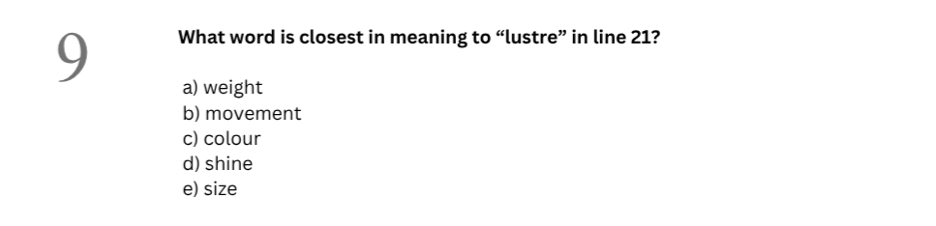
Literal understanding
These questions require candidates to locate and understand a detail stated directly in the passage. The challenge often lies in finding the relevant evidence quickly and distinguishing it from similar information elsewhere in the text.
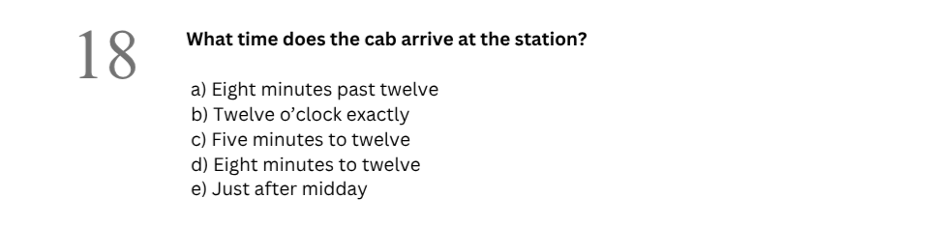
Inference
Inference questions require children to work out what is suggested rather than directly stated. They may need to interpret a character’s feelings or motives, identify the atmosphere of a passage or draw a conclusion from several pieces of textual evidence.
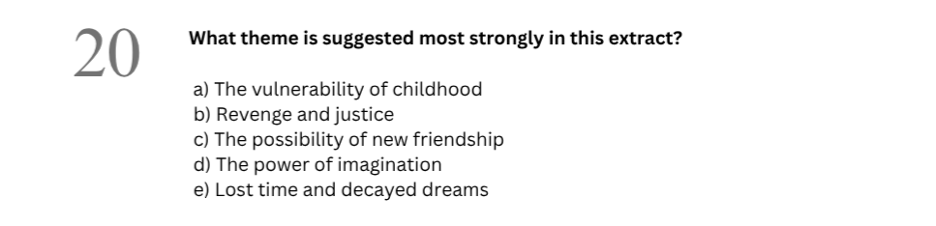
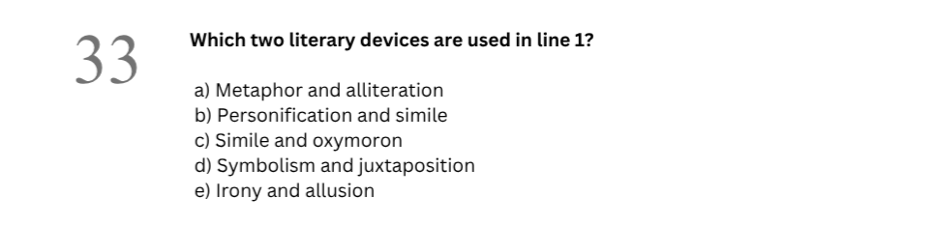
The Writer’s Use of Language
Candidates may be asked why a particular word, phrase or sentence has been used, or what effect it creates. Questions can also test recognition of literary devices such as metaphor, simile, personification or contrast.
The aim is not simply to name a technique. Children need to understand how the writer’s choice contributes to meaning, tone or atmosphere.
Word Classes in Context
Some comprehension questions also test whether candidates can identify how a word functions within a particular sentence—for example, as a noun, verb, pronoun, adjective, determiner, conjunction or adverb.
A word’s function can change according to how it is used, so children need to examine the complete sentence rather than identify the word class from the word alone. This is one of the areas where word-class knowledge and comprehension overlap to test whether your son can interpret how language works in practice.
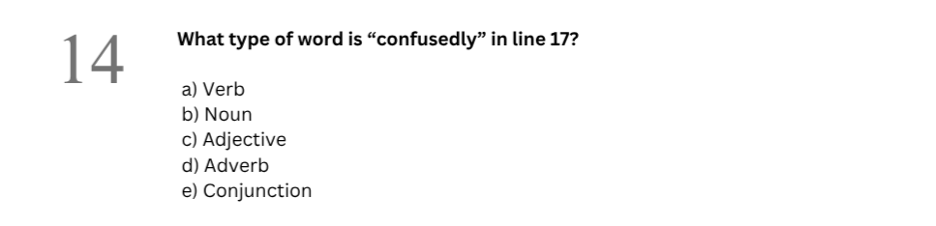 Unlike many SPaG questions, comprehension does not always depend on applying one fixed rule. However, it should not be approached through guesswork or instinct. Strong answers come from understanding the text, locating relevant evidence and comparing every answer option carefully.
Wide reading helps build the necessary vocabulary and familiarity with different writing styles, but children must also practise answering appropriately challenging questions and reviewing why incorrect options are wrong.
How to Improve 11+ Comprehension Skills
Comprehension is often the part of the 11+ that parents find hardest to support at home. SPaG has identifiable rules, whereas comprehension can initially appear more subjective.
This does not mean that comprehension depends on “gut feeling”. Strong answers should be supported by the passage. The difficulty is that children must locate the relevant evidence, interpret what it suggests and distinguish the best answer from several plausible alternatives.
Some children read fluently but struggle when asked why a character behaved in a particular way or what a word means in context. This often happens because fluent reading has become passive: the child reaches the end of the passage without actively processing its details, language and implications.
Comprehension can be improved, but it needs to be taught as an active, evidence-based process.
How Do You Improve Poor Comprehension for the 11+?
The most effective starting point is to make reading more interactive. Children need to engage with a passage rather than simply finish it.
Useful approaches include:
- Read aloud selectively: Reading a difficult paragraph aloud can help a child slow down and notice how sentence structure and punctuation affect meaning. However, children must also develop confident silent reading because that is how they will normally work in the examination.
- Pause for discussion: After several paragraphs, ask questions such as, “Why did the character react in that way?”, “Which words create that impression?” or “How does this description affect the mood?” Always ask your child to identify the evidence supporting the answer.
- Encourage prediction: Pause part-way through a passage and ask what might happen next and why. The value lies not in predicting correctly but in using tone, character behaviour and details from the text to justify the prediction.
- Clarify vocabulary in context: Before reaching for a dictionary, ask your child to use the surrounding sentence and paragraph to work out the likely meaning of an unfamiliar word.
- Make relevant connections: Discuss whether a scene, character or idea resembles something encountered in another book, a historical event or real life. This can help children connect unfamiliar material with existing knowledge.
- Use short extracts as well as complete papers: A single paragraph can be used to explore vocabulary, inference, tone or figurative language without overwhelming the child. Full passages and timed papers can be introduced once the underlying skills are more secure.
Interactive reading teaches children to consider the why behind a passage rather than merely getting through it.
Related reading: How to Improve Reading Speed and Comprehension.
How Can My Child Improve Their 11+ Comprehension Score?
QE Boys does not publish a separate pass mark for comprehension or English. Candidates receive a combined age-standardised entrance-test score based on their English and Maths results, and currently require an overall score of 225 or higher to be eligible for consideration for admission.
Every additional English mark can therefore matter in a highly competitive admissions process. Useful exam-focused strategies include:
- Identify the question type: Before answering, determine whether the question is testing retrieval, inference, vocabulary, word classes or the writer’s use of language. Different question types require different approaches.
- Return to the evidence: Children should avoid answering from memory when the passage is available. Locate the relevant sentence or paragraph and check every answer against it.
- Compare all the options: In a demanding multiple-choice question, one answer may be broadly true while another is more precisely supported by the passage. Children should not select the first plausible option without considering the alternatives.
- Annotate purposefully during practice: Underlining key words, marking relevant evidence and noting changes in speaker, time or mood can prevent passive reading. Annotation should remain selective; marking too much can waste time and make the passage harder to navigate. Children should follow the school’s instructions in the actual examination.
- Develop inference systematically: Ask three questions: What do I think? What evidence supports it? What does that evidence suggest? This prevents inference from becoming unsupported guesswork.
- Build vocabulary steadily: Vocabulary is difficult to improve at the last minute. Regular reading, discussion and review of unfamiliar words are more useful than relying solely on long, disconnected word lists.
- Introduce timing gradually: Children should first learn to answer accurately without excessive time pressure. Once the method is secure, use timed sections and then complete papers containing two passages. Starting intensive timed work too early can reinforce rushed reading and careless errors.
- Review answers thoroughly: Do not simply record the score and move to another paper. Discuss why the correct option is supported and why each alternative is weaker or incorrect.
Achieve Learning insight
In our experience, completing more comprehension papers does not automatically produce better results. We have seen children repeat the same mistakes across multiple papers because scores were recorded but the underlying causes were never identified.
After each paper, separate errors into categories such as vocabulary, information retrieval, inference, language analysis, word classes and time management. This shows whether the child has a broad comprehension weakness or a smaller number of specific problems requiring targeted work.
A child repeatedly losing inference marks needs a different response from one who understands the passages but runs out of time. Accurate diagnosis should come before simply increasing the volume of practice.
The central principle is active, evidence-based reading. Children who learn to question a text, locate supporting evidence and evaluate alternative answers are better equipped to deal with unfamiliar and demanding passages.
QE Boys English Preparation from Achieve Learning
The QE Boys English examination requires preparation across both comprehension and SPaG. Comprehension tests sustained reading, vocabulary and interpretation, while SPaG requires detailed grammatical knowledge and accuracy.
Achieve Learning currently offers:
- QE Boys 11+ English practice packs containing two full-length comprehension papers, a bonus SPaG paper, detailed answers and vocabulary support;
- Individual 11+ guidance sessions for parents seeking school-specific advice, diagnostic review or a personalised preparation strategy;
- registration for our planned 2027 in-person mock examinations; and
- registration for planned 2027 online tuition, revision courses and school-specific masterclasses.
The development and review of Achieve Learning’s 11+ exam papers are informed by the organisation’s experience of selective-school preparation since 2004. They also incorporate expert oversight, candidate testing and feedback received from students following their actual 11+ examinations.
Explore QE Boys 11+ English Practice Papers
About the Author
Firoz Jetha is the founder of Achieve Learning.
Firoz has 30 years’ experience working with children and families across education, academic support and guidance. His work in the sector began before he founded Achieve Learning in 2004 and has since included supporting families preparing for competitive grammar and selective-school entrance examinations, including Queen Elizabeth’s School, Barnet and the South West Hertfordshire Consortium.
Firoz personally provides Achieve Learning’s individual 11+ guidance sessions and oversees the development and review of its specialist practice papers.
View Firoz Jetha’s author profile and articles · About Achieve Learning


